Ethanol fireplaces
Custom Ethanol Fireplaces
Custom ethanol fireplaces are built-in bioethanol pieces made to a brief: customised widths on slim built-in models, and fireboxes made to order across the published width range of 800–3000mm.
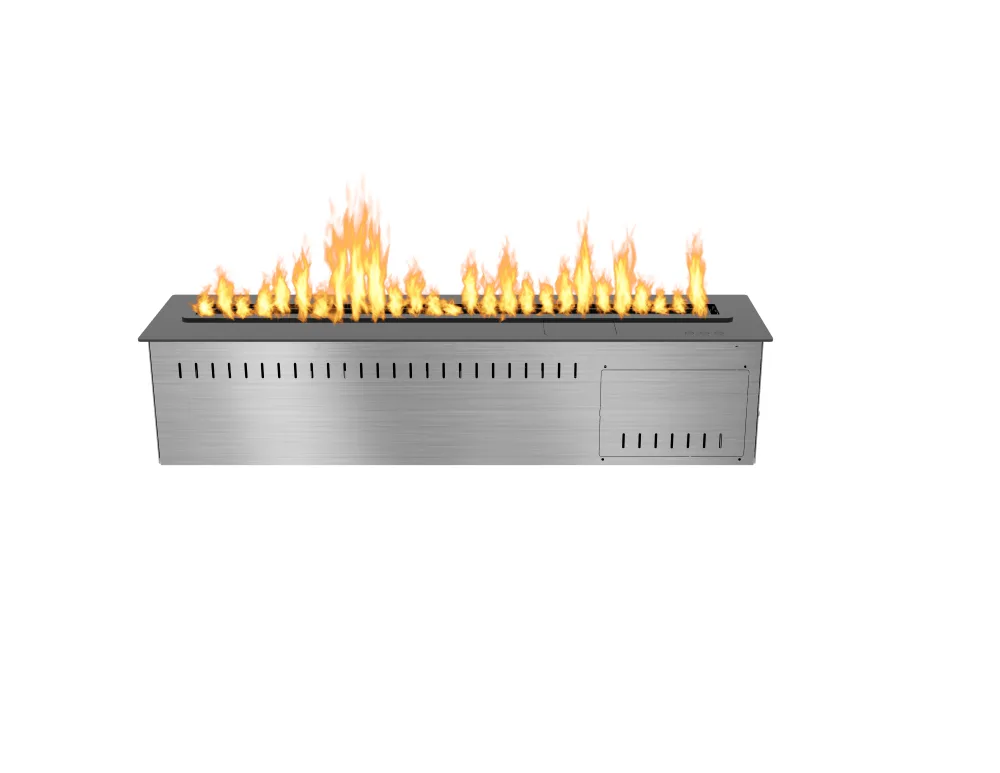
What custom covers: custom ethanol fireplaces
Custom work in the ethanol range means the fireplace is made to the project's dimensions and configuration instead of picked from standard sizes. Two routes carry most of it: slim built-in ethanol models supplied at customised widths, and fireboxes made to order as single-sided, double-sided, tunnel or corner constructions. Both are regular production for the factory, ordered through the same inquiry route as standard items.
A custom brief is not a request for a different kind of fireplace. The fuel, the flame and the control options are the same as the standard range; what changes is the fit. The opening is unusual, the wall is a divider, the view is from two sides, or the width falls between sizes — the custom route answers the fit question while keeping the proven working parts.
The custom process, from brief to order
A custom order starts with the opening and the view: the width, height and depth of the construction, and the sides the flame will be seen from. Those two facts select the route — a customised-width built-in model where the form is standard, or a made-to-order firebox where the form itself is the variable. Control is settled next: intelligent control where the fireplace joins a managed interior, manual where it stands alone.
The brief should arrive as measurements and plain statements, not as a product name. Width in millimetres, viewing sides as a count and a description, the wall material, and the control type. With those four in the inquiry, the configuration can be confirmed in writing before production, and the confirmation travels with the order as its record.
Widths and viewing sides
Fireboxes are published across a width range of 800–3000mm, which covers everything from a compact single-sided box to a wide divider construction. Within that range, the viewing sides do the design work: a double-sided box divides a room into two seating areas with one fire; a tunnel box is seen through from room to room; a corner box wraps the flame around a turn in the wall.
Slim built-in models answer a different constraint: depth. Where the wall construction is shallow, a slim semi-automatic model at a customised width keeps the flame while giving up the least wall thickness. Depth, like width, belongs in the brief in millimetres, beside the item it constrains.
Requirements checklist for a custom brief
| Requirement | What to state |
|---|---|
| Opening dimensions | Width, height and depth, in millimetres |
| Viewing sides | Single, double, tunnel or corner, with a short description |
| Wall construction | Material and thickness the unit is built into |
| Control | Intelligent or manual; smart-home system where one applies |
| Quantities | The quantity beside each distinct configuration |
Each distinct configuration is its own line in the inquiry. Two fireboxes of the same width but different viewing sides are two items, not one item with a note, because their construction differs. The checklist table gives the fields; the confirm box below gives the short form of the same discipline.
Photographs and drawings travel well with a custom brief, and buyers who have them should say so in the inquiry even if the files follow in a second message. A photograph of the wall or the divider answers in one glance the questions that take paragraphs in words — proportions, neighbours, light — and the confirmation can then refer to the actual construction rather than to a description of it.
Related pages
Send an inquiry
Send your custom brief with the product list. Put dimensions, viewing sides and control beside each configuration.