Fireplace boxes
Corner Fireboxes
A corner firebox wraps the flame around a turn: an ethanol firebox built at a wall's edge, so the fire is watched from two directions at once.
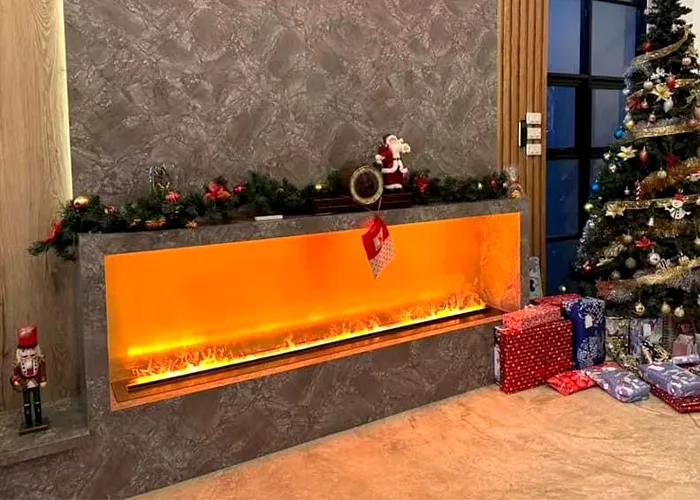
What a corner firebox does: corner fireboxes
A corner firebox is built where two faces of a construction meet: at the end of a wall, on the corner of a divider, or at the turn of an L-shaped room. The chamber is glazed on two adjoining faces, so a single bioethanol flame is visible from both directions and the fire reads as a property of the corner itself. It is the form that turns leftover geometry — the end of a wall nothing else uses — into the room's feature.
The box is made to order, across the family's published width range, to the corner it will occupy. Left-hand and right-hand arrangements are different constructions, and which one a project needs is decided by standing in the room: the glazed faces turn toward the seating, the closed faces toward the wall runs.
Corner geometry: which way the fire turns
The brief for a corner box is mostly geometry. The corner's position, the lengths of the two wall runs it sits between, and the seating it faces fix the arrangement. A corner at the end of a room divider serves two seating areas at right angles; a corner on a chimney-style projection serves one room from two viewpoints. The two briefs produce different boxes, and the inquiry should describe the corner in plain words rather than rely on the form name alone.
Width on a corner box is measured along its main face. The return face follows the construction. Buyers who have a drawing can send its dimensions as the written brief; buyers who do not should give the main-face width, the corner's position and the seating it serves, and let the confirmation settle the return.
Corner boxes in a wider firebox order
Corner boxes rarely travel alone. A project with a corner feature in one room often holds a single-sided box in another and a double sided divider in a third, and the firebox category discipline applies: one line per form, widths beside each, control marked per line. The forms are never merged into a single fireboxes line, because each is a different construction with its own confirmation points.
Control choice follows the room, as everywhere in the family: intelligent control where the fireplace joins a managed interior, manual where it stands alone. A corner box in a serviced venue usually takes the managed route; in a residence the choice is the household's routine, and either is a regular order.
Confirming a corner order
| Point | What to confirm |
|---|---|
| Corner position | End of divider, wall turn or projection, described in words |
| Arrangement | Which faces are glazed toward the seating |
| Main-face width | In millimetres, along the principal face |
| Control | Intelligent or manual |
The arrangement line is the corner box's version of the double sided box's operator side: the fact that cannot be inferred and cannot be changed after the build. Describe it, even briefly, and the confirmation answers it once.
Corners reward a site photograph more than any other form in the family. A corner is a piece of geometry that prose handles clumsily and a camera handles in a second: the two wall runs, the seating, the light. Buyers who can photograph the corner should say the photographs exist in the inquiry, so they can be asked for by name and read alongside the measurements rather than instead of them.
Related pages
Send an inquiry
Send your product list and quantities for a quote. Describe the corner and its glazed faces beside each corner box.