What Is an Ethanol Fireplace?
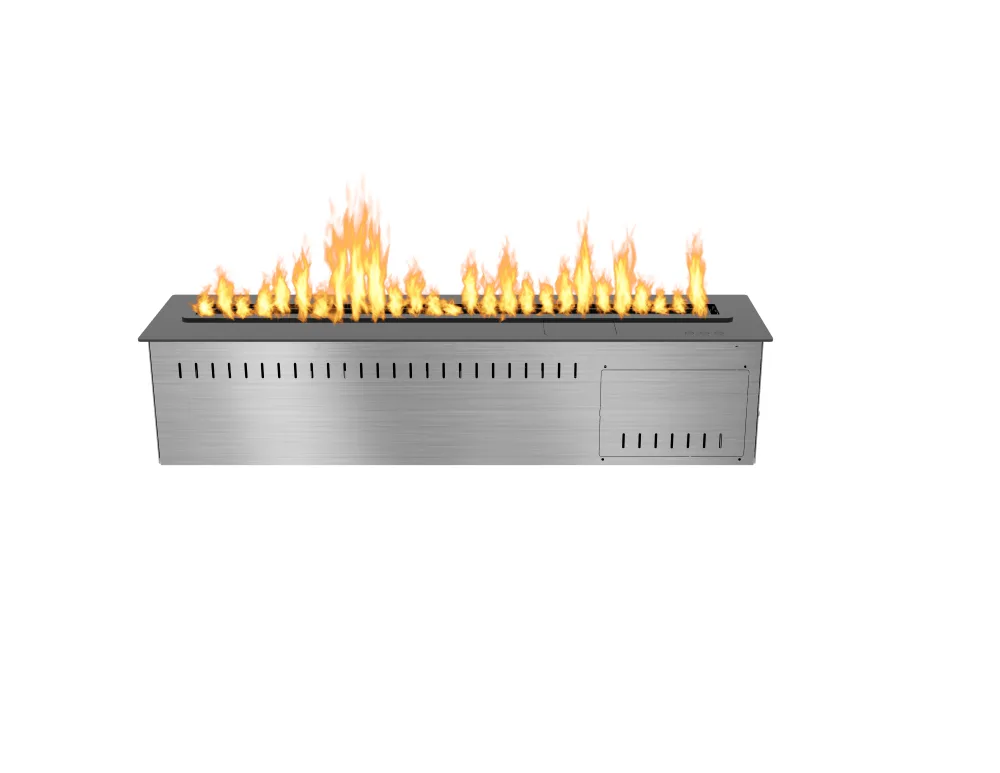
An ethanol fireplace is a real-flame fireplace that burns bioethanol fuel in a burner — no chimney, no flue, no gas line, and a flame you can build into a wall, stand on a floor or set on a table.
The short answer
An ethanol fireplace burns a liquid fuel — bioethanol — in a purpose-built burner, and gives a real flame. That sentence contains the whole product. The flame is not an effect, a picture or a projection: fuel is poured into a reservoir, lit, and burns until it is shut off or the fuel is spent. Everything attractive and everything demanding about the product follows from the flame being real.
The name travels in two forms. Ethanol fireplace and bioethanol fireplace describe the same products; the longer word names the fuel's plant origin. Listings, shops and manufacturers use both, sometimes for the same model, and buyers collecting a list across regions should treat the two as one family from the start.
Why there is no chimney
A chimney exists to remove smoke. Bioethanol burns without smoke, so an ethanol fireplace needs no flue, no vent and no chimney breast. That absence is the product's great practical freedom: a real flame can be built into a divider wall, a media wall, an apartment, a converted space — anywhere a construction can hold it — without the building work a wood or gas fire demands.
Ventless is a description of the installation, not a promise about the room. A burning flame still warms the air, still gives off water vapour, and still consumes oxygen. The room is therefore part of the product's specification, and the room questions are taken in full in the ventless guide: size, airing, and who owns the fuelling routine.
The parts of an ethanol fireplace
Every ethanol fireplace is a burner plus a housing. The burner holds the fuel, presents the flame opening, and on some models carries the extinguishing and adjustment mechanism. The housing is everything around it: the insert's finished case, the firebox's chamber, the surround a project builds, the body of a freestanding or tabletop piece. Products differ first by which of those housings they are.
Controls divide the range further. Manual fireplaces are lit and adjusted at the unit. The smart line lights and adjusts by remote control and app, with smart-home links. The flame is the same across that divide; the daily routine is not, and buyers feel the difference every time the fire is used, which is why control is a first-order choice rather than an accessory.
The forms it comes in
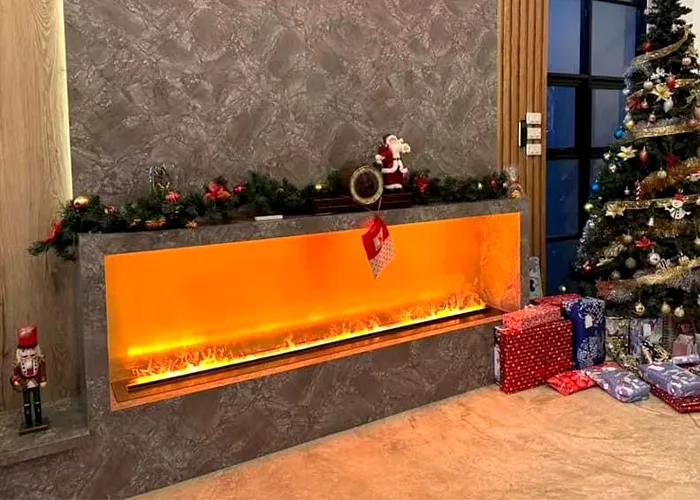
Built-in forms lead the range: inserts that drop into prepared openings, fireboxes made to order in single-sided, double-sided, tunnel and corner forms, and burners supplied as components for bespoke surrounds. Slim built-in models at customised widths serve shallow walls, and ultra-long linear models serve wide ones. The built-in family is where the product becomes architecture.
Placed forms complete it: freestanding fireplaces that stand in the room as furniture, wall-mounted models that fix to the wall, tabletop pieces for surfaces, and fire pits that take the flame outdoors. A single order often mixes built-in and placed forms — a feature fire built in, secondary fires placed — with one fuel and one handling routine across the whole set.
The fuel and the routine
Bioethanol for fireplaces is a bottled liquid fuel, supplied by the buyer locally. The routine is simple and strict: the burner is filled when cool, lit, enjoyed, and left to cool fully before it is filled again; fuel is never added to a burning or warm burner. That single discipline, stated in the safety guide, is the habit the whole family runs on.
The fuel is also why the product suits rooms without services. No gas line to run, no flue to build, no electrical installation beyond what smart control asks for: the fireplace's needs are a suitable construction and a bottle of fuel. Renovations, rentals and events all use the product for exactly that lightness.
What it is not
An ethanol fireplace is not a heating system. A real flame warms its surroundings, but the product is specified as a fire, not as a boiler; rooms that need heating plan heating separately, and the flame-effect families with heater models exist for buyers who want warmth from the fireplace opening itself. Judging an ethanol fireplace as a heater judges it at a job it does not claim.
It is also not a flame effect. Where a real flame cannot be used — audiences sitting close for long hours, spaces where combustion is not permitted, rooms run by staff who cannot own a fuelling routine — the answer is the vapor or electric family, not a reluctantly placed ethanol fire. The comparison page sets the two flame families side by side for that decision.
Who buys it, and how
Trade buyers — importers, distributors, project buyers, retailers — order the range against written inquiries: a product list with forms, sizes, controls and quantities, headed by the destination market. The manufacturer confirms each line in writing before an order is placed. For a first list, the confirm boxes are the checklist: they collect, family by family, exactly the facts a confirmation needs.
Sizes, models and a first order
The range is published in graduated sizes and named lines rather than as a single standard product, which is why a first order usually pairs the form decision with a size decision. An insert is chosen against its opening, a linear model against its wall, a vapor or electric piece against its furniture. Buyers who have not yet measured should not guess a size to keep the list moving: an inquiry that states the form and the room, with the measurement marked as to follow, is confirmed more honestly than one carrying a borrowed dimension.
A sensible first order often mixes ambition: the main feature specified fully, the secondary pieces specified by form and room with their measurements taken from the site, and a tabletop piece or two included as the household's or the venue's hands-on introduction to the fuel and the routine. That shape of list is common enough to be unremarkable, and it has the virtue that every line in it can be confirmed as written — which, for a product defined by a real flame in a real room, is the whole method. The fireplace that results from such a list is not a compromise between the catalogue and the room; it is the point where the two were made to agree, on paper, before anything was built or shipped.
Related pages
Send an inquiry
Send your product list and quantities for a quote. State the form and the control beside each item.